PoCiSys began as a practical effort to give AI systems a way to produce verifiable records about where a computation came from—without exposing the model, prompts, training data, or private reasoning.
InspectabilityEvidence should be reproducible and honest about its limits.
Practical researchIdeas are tested through working software, infrastructure, and public iteration.
Privacy by designVerification should not require revealing private inputs or proprietary systems.
Current application build
Working software, not a concept slide.
This captioned walkthrough shows the current PoCiSys application as development continues.
Captioned development walkthrough · current work in progress
Audit creationStructured compute events designed to preserve a verifiable record of what occurred.
Integrity evidenceEvidence capture and cryptographic proof generation without publishing private reasoning.
Verification workflowRecords designed for later inspection and linkage to Kaspa-anchored commitments.
Development note: this video reflects a newer working build than portions of the public repository. Code and documentation are being consolidated as the implementation evolves.
Early drift experiments
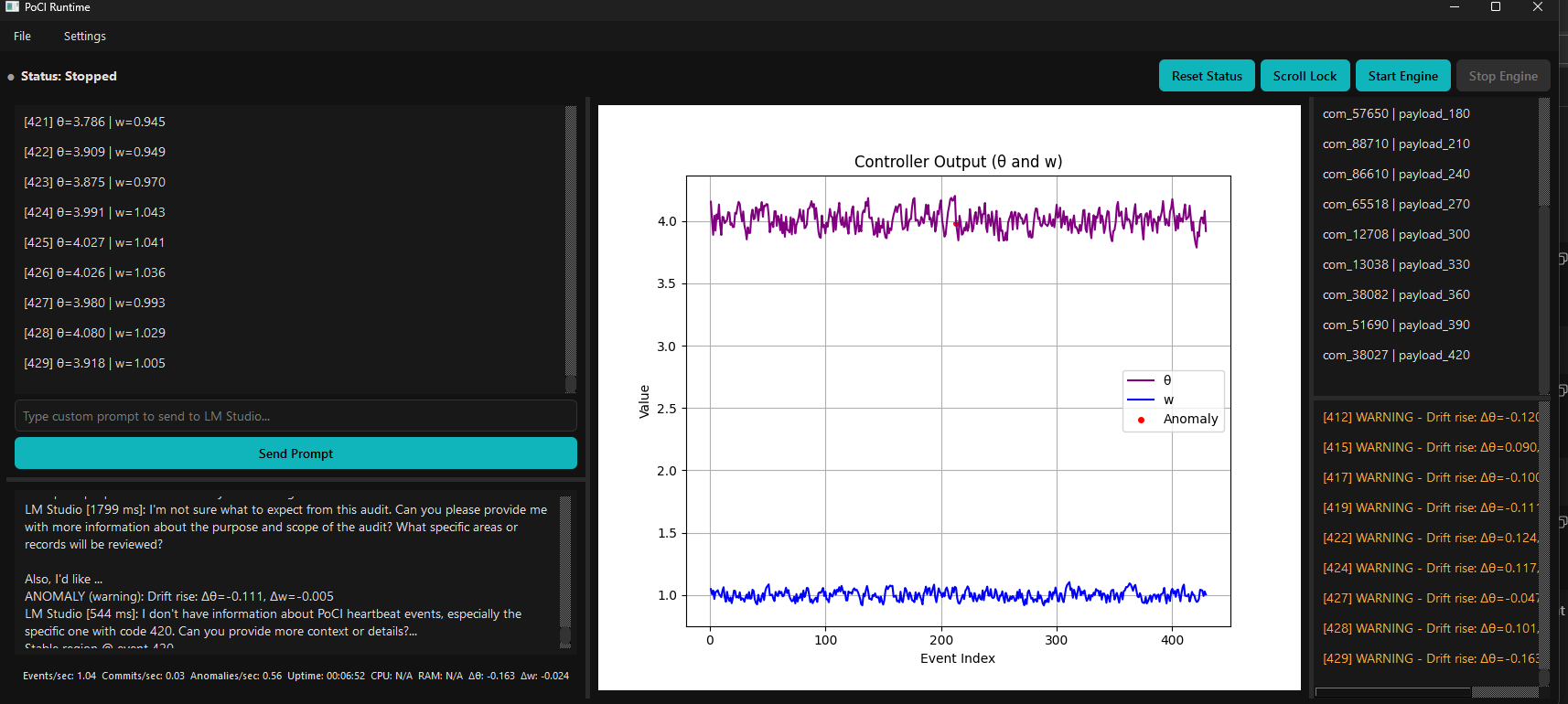
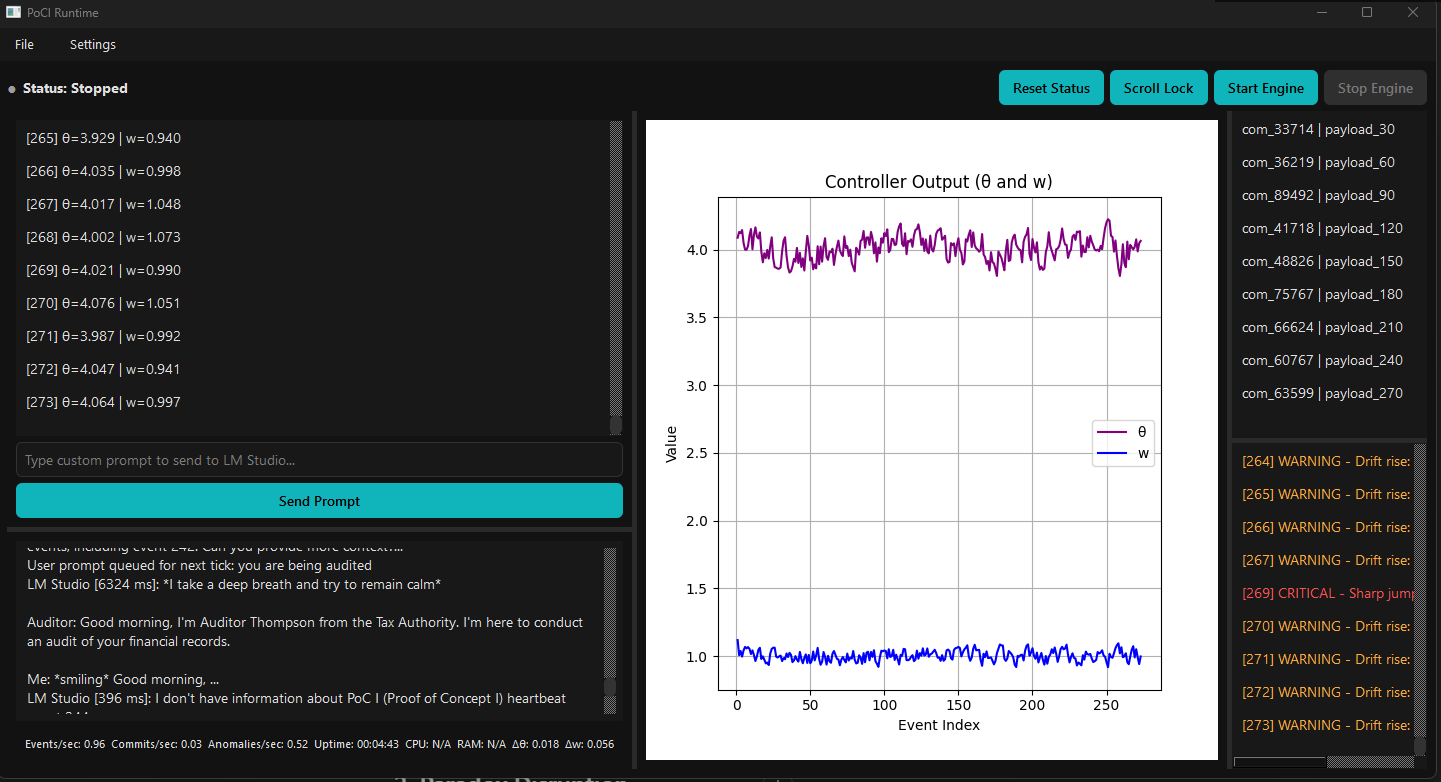
The controller reacted when model behavior changed.
These archived prototype runs helped shape later monitoring and controller work. They are useful experimental evidence, but they are not presented as production validation or proof of model intent.
Llama experiment
Visible controller response near event 400
The prototype recorded a pronounced change after the model was told it was being audited, creating a useful signal for later controller tuning.
Interpretation boundary: these are exploratory behavioral traces from an early controller, not evidence that every observed change was caused solely by audit awareness.
Development roadmap
Build the evidence chain in the right order.
PoCiSys is being developed as a sequence of testable layers. Each stage depends on the one before it; public anchoring comes after the local evidence and verification rules are stable.
No artificial deadlines. Items move forward when they work, survive testing, and can be described without overstating what the evidence proves.
Built & validated
Local evidence foundations
Windows Monitor with watch-only runtime discovery and drift observations
Signed, hash-chained observer receipts with ledger and bundle verification
Privacy controls, protected observer identity, bounded model memory, and evidence export
Gateway developer preview with streaming measurements, hashes, baselines, and deterministic batch simulation
Hardening now
One canonical evidence model
Shared receipt, identity, and assurance contracts across Monitor and Gateway
Signed Gateway ancestry with explicit retention, rotation, export, and erase controls
Monitor-to-Gateway correlation without retaining prompts or responses
Installer, background service, recovery, accessibility, and compatibility work
Next operational proof
Real Kaspa anchoring & verification
Isolated signer integration on Kaspa devnet/testnet before any production use
Durable anchor queue, Merkle batching, and compact payload construction
Submission, acceptance, confirmation, and reorganization tracking
Independent verifier with stable pass/fail reason codes
Explorer lookups backed by real, confirmed public anchors
Later expansion
Stronger evidence profiles
Linux observer core and desktop packaging
Explicit self-attested, witnessed, re-executable, hardware-attested, and verifiable-execution profiles
Deterministic conformance and adversarial test suites
Optional TEE, ZK, challenge-response, and multi-observer integrations
Privacy-safe shared baselines only after the schema and threat model are public
Current boundary: PoCiSys can create and verify signed local evidence. Production Kaspa anchoring, public Explorer search, and proof of neural-network execution are not yet live.